When you search for dental facilities near me, check more than the address. A suitable practice needs to work for your mobility, communication, sensory and support needs, from arriving at the entrance to receiving care in the dental chair. The most useful first step is to contact the practice with specific questions before booking.
A website description such as “accessible” may not answer everything you need to know. Ask the team to confirm the details that matter to you, rather than assuming a ramp or ground-floor entrance makes the whole appointment accessible.
Start with the adjustments you need
Accessibility means different things to different people. You might need step-free entry, room for a mobility aid, information in writing or breaks during treatment. Chronic pain, fatigue, hearing loss, low vision and sensory sensitivities can also affect how an appointment needs to be planned.
Describe what helps you use a service, rather than feeling you must explain your whole medical history to reception. For example, “I cannot transfer from my wheelchair without assistance” gives the team a practical question to resolve. Relevant medical information should also be discussed with your treating dentist.
Think about the entire visit: transport, arrival, waiting, treatment and getting home. If one part is uncertain, ask the practice to check it before you commit to an appointment. An adjustment that sounds minor, such as somewhere to sit while checking in, may make a meaningful difference.
Questions to ask “dental facilities near me” before booking
Ask for concrete information rather than a general assurance that the building is accessible. These questions can help you identify what needs further discussion.
| Part of the visit | What to confirm |
|---|---|
| Parking and drop-off | Where accessible parking or a suitable drop-off point is located, and the route to the entrance |
| Building entry | Whether there are steps, kerbs, heavy doors or ramps along that route |
| Lift access | Lift dimensions and access arrangements if the practice is above ground level |
| Internal space | Clear doorway widths, tight turns and space for your mobility aid in the treatment room |
| Toilets | Whether an accessible toilet is available and where it is located |
| Waiting area | Suitable seating and space for a wheelchair, mobility aid or support person |
| Appointment support | Who can discuss communication needs, transfers and other adjustments before the visit |
If measurements matter, provide the dimensions of your wheelchair or mobility aid. Recent photographs may help clarify an entrance or corridor, but they do not replace measurements or a discussion about your needs.
Check the exact address and entrance, particularly when a practice is inside a larger building.
Check whether treatment itself will be accessible
When comparing results for “dental facilities near me”, check the treatment setup as well as the entrance. Being able to enter a practice does not necessarily mean its dental chair or room layout will suit you.
If you use a wheelchair, ask whether a transfer would be required and how the team would assess this safely. Explain any assistance or equipment you normally use. Do not assume staff can lift you, that a hoist is available or that your usual transfer method can be used in that room.
Some dental care may be possible while a person remains in their wheelchair, but this depends on the procedure, chair positioning, equipment and clinical assessment. It cannot be confirmed from a website alone.
Also mention if you cannot recline fully, need support for your neck or joints, or have difficulty keeping your mouth open. The dentist can discuss whether positioning changes, shorter visits or another approach may be appropriate. These arrangements should be assessed before treatment, not improvised on arrival.
Make communication and consent accessible
Clear communication is part of healthcare access. The Australian Charter of Healthcare Rights describes rights including access, respect, partnership and information.
When contacting clinics found through “dental facilities near me”, explain how you prefer to communicate. This might include written instructions, plain-language explanations, large-print information or time to use a communication device.
If you need an Auslan or language interpreter, ask whether one can be arranged, who organises it and whether any costs apply. A support person may help you communicate, but does not automatically have authority to consent on your behalf.
Before an examination or treatment, discuss how the dentist will explain what is happening and agree on a way to pause, such as raising your hand. Information about proposed care should cover its purpose, potential benefits, risks, costs and alternatives in a format you can understand.
If knowing the sequence would help, our guide to what happens at a dental check-up explains the usual parts of a routine visit. Your appointment may be adapted following discussion with the team.
Ask about sensory comfort and appointment pacing
Dental settings can involve bright lights, unfamiliar sounds, close contact and strong tastes or smells. Tell the team which aspects are difficult and what has helped during previous healthcare visits.
You could ask about a quieter appointment time, waiting outside until the room is ready, breaks or an explanation before each part of the examination. These are requests to discuss, not features to assume a practice can provide. Some sounds, lighting and equipment are necessary for safe care.
If anxiety is a concern, ask to discuss it before treatment begins. Sedation is not a substitute for accessible communication or a safe transfer plan. If it is being considered, it requires an individual clinical assessment and discussion of its potential benefits, risks and any recovery or transport requirements.
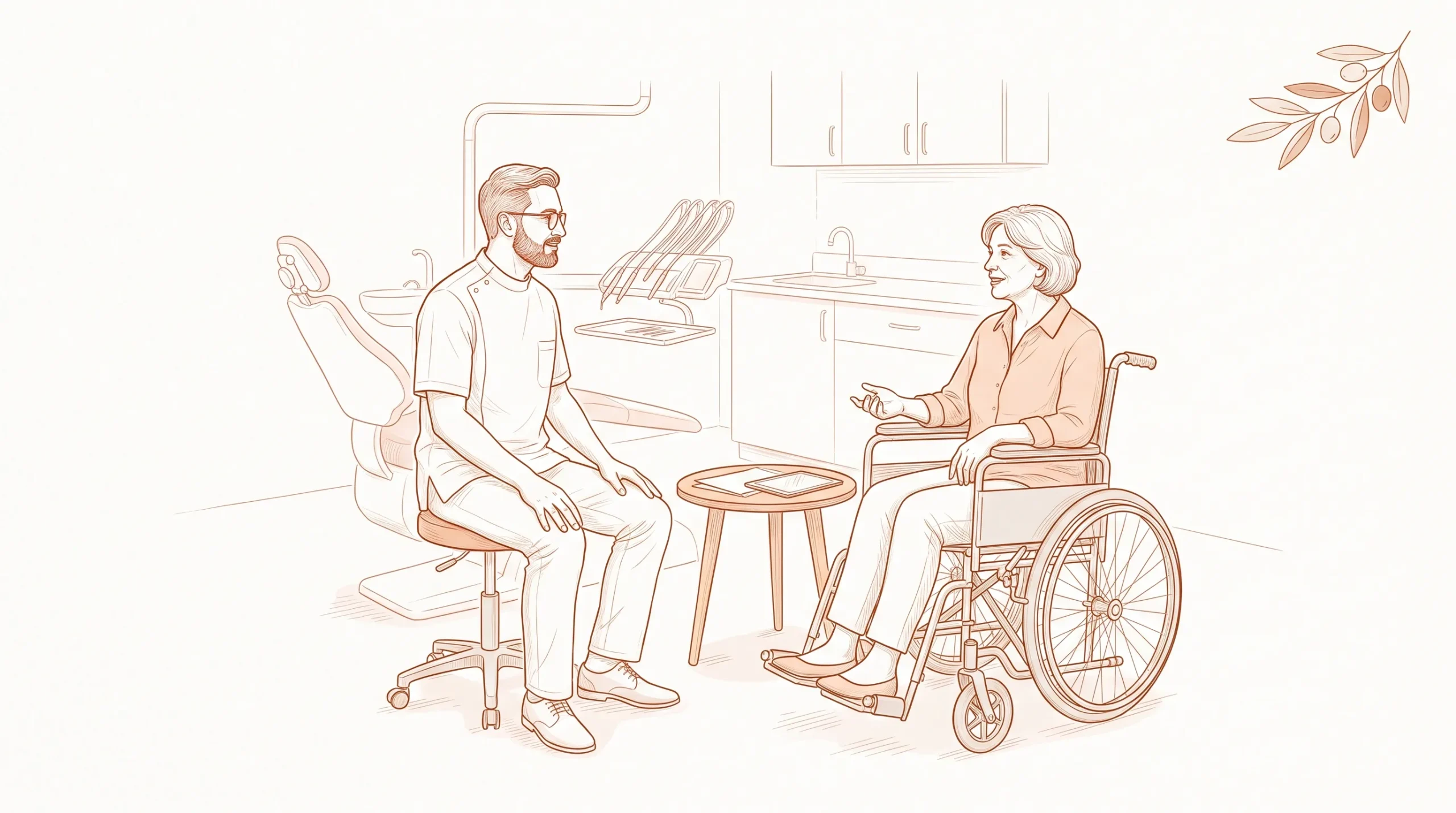
Illustration only, not a depiction of a particular CP Dental practice.
Agree on arrangements before the appointment
Once the practice has checked your requirements, ask for confirmation through your preferred contact method. This could cover the entrance to use, who to contact on arrival, the appointment length and any agreed communication or positioning arrangements.
Ask whether the first visit will be an examination, a planning discussion or treatment. These are different appointments, and the team may need clinical information before confirming what can be provided. Our guide to dental clinic services to ask about before booking can help you clarify the appointment’s purpose.
When shortlisting “dental facilities near me”, include costs in the conversation. Ask what the consultation covers and whether extra appointment time, interpreting or other arrangements affect fees. Do not assume an adjustment is either free or chargeable. Our guide to questions about affordable dental care explains how to discuss estimates and possible additional costs.
Share relevant medical conditions, medicines and allergies with the treating team. If fatigue or transport arrangements limit your available time, explain this before booking.
A message you can adapt
I would like to book a dental assessment and need to check access first. I use [mobility aid or communication support] and need [specific adjustment]. Could someone confirm the entrance, treatment-room access and whether a transfer would be required? I would also like to know whether my support person can attend and whether these arrangements affect the appointment length or fees. Please contact me by [preferred method].
You can keep this brief. The aim is to give the practice enough information to investigate your requirements, then arrange a more detailed conversation where needed.
If a practice cannot meet your needs
Ask which part of the visit cannot be accommodated and whether an alternative arrangement can be assessed. A different room or appointment format may be worth discussing, but it will not resolve every access issue.
If the practice cannot provide care safely in its setting, ask your dentist about an appropriate referral. Depending on your circumstances, a service experienced in special needs dentistry may be considered. Availability, eligibility and referral requirements vary.
If access difficulties are delaying care for pain, swelling or another dental concern, tell the practice when you contact them so your symptoms and access requirements can be considered together.
Frequently asked questions
How can I compare dental facilities near me when websites provide little access information? Contact each practice with the same specific questions. Ask staff to check uncertain details, such as doorway measurements or transfer arrangements, rather than relying on a general accessibility description.
Does wheelchair access mean I can stay in my wheelchair during treatment? Not necessarily. Building access and treatment access are separate questions. The dentist needs to assess whether your wheelchair, the room setup and the proposed procedure allow care without a transfer.
Can I bring a support person? Ask before booking so the team can consider room space, privacy and clinical requirements. Explain what assistance the person provides and how you would like them involved in discussions.
Do I need to book a longer appointment? Not always. Explain your needs first and ask what appointment length is appropriate. Extra time may be useful for communication, positioning or breaks, but arrangements depend on your circumstances and the planned care.
Discuss your access needs with CP Dental
CP Dental sees patients at its Coopers Plains, Mater Hill and Emerald locations. Before booking, contact the team to confirm the facilities and arrangements at your chosen practice. Accessibility features should not be assumed to be the same across locations.
You can contact CP Dental about an appointment to explain your requirements and ask what needs to be assessed before your visit.